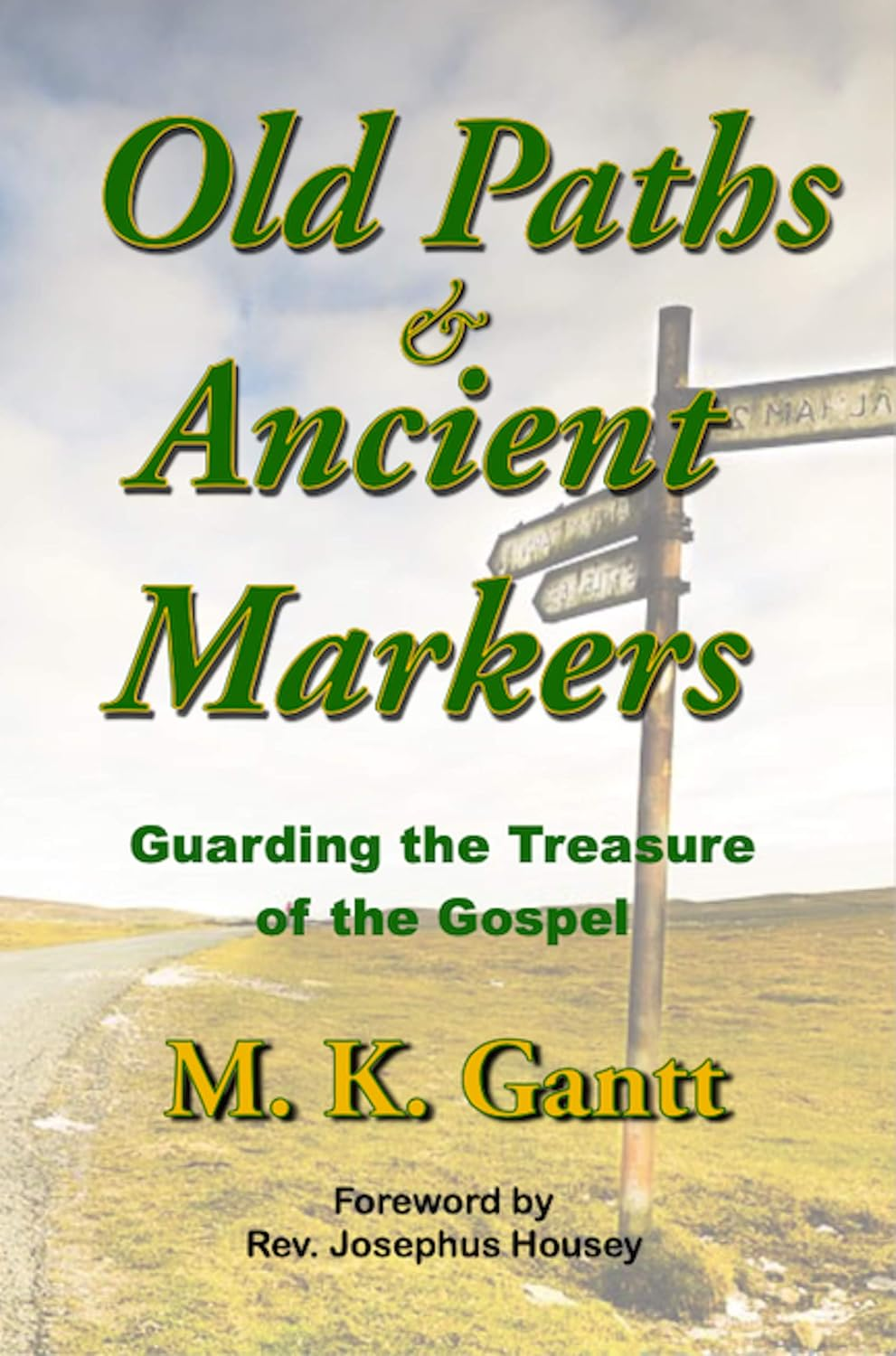

In a relay race, the baton does its work in a narrow stretch of track where one runner's race ends and another's begins. Fast teams lose there. Nothing run in the first leg matters if the second is never properly begun. Michael Gantt returns to that image throughout Old Paths and Ancient Markers: Guarding the Treasure of the Gospel, and he presses on what it implies for the person holding the baton. Paul's charge to Timothy, which supplies the book's subtitle, is usually read as an instruction to protect something. Gantt reads it as an instruction to protect it by handing it on: to guard the gospel is to place it, intact, in the hands of people who can carry it further. A believer who keeps the faith flawlessly and passes on nothing, in this reading, has run one leg and stopped.
The book makes that argument about fathers, churches, culture, and Scripture. But there is a person inside the argument. Gantt writes that he never knew his father, and that God "sent a man into my life who became the only father I ever knew." To understand what he asks of other men, it helps to begin with what was given to him. It also helps to know what he says went wrong along the way, because the book is as frank about the second as it is about the first.
Why a man who received so much would still, by his own account, let something slip in the exchange is the question this profile follows.
A Chain of Custody
The book's scriptural frame is Paul's second letter to Timothy: guard the good deposit, and entrust what you have heard to faithful people who will teach others. Gantt opens by imagining Paul in a Roman prison near the end of his life, a scene he dramatizes with invented detail and one best read as a way of giving the charge its human weight. In it Paul knows that his leg of the race is nearly over, and that others are ready to run.
What interests Gantt is how concrete the chain is. It is made of people: Paul and Timothy, and behind Timothy a grandmother, Lois, and a mother, Eunice. Gantt measures himself against that picture and finds a difference. "Unlike Timothy, I did not grow up in the faith," he writes, and there was "no grandmother Lois or Eunice" in his life. What he had instead was a "Paul." Chapter 2, "A Covenant Line," draws its conclusion from the pattern: "We are told to make disciples, not converts."
To guard the gospel is to place it, intact, in other hands. This is an editorial reading of 2 Timothy, not a quotation from the book.
That distinction between holding a belief and handing on a trust is the book's organizing tension. Chapter 3, "The Word Can Be Bound!", locates the danger less in outside attack than in believers themselves, through timidity and shame about their own witness. A chain, on this account, more often breaks from a link that stops reaching. Who the first link in Gantt's own chain was, and what he gave, is where the story turns personal.
The Man Who Was Given a Father
At sixteen months old, Gantt was left in the care of Clarence and Ruby Long, who kept foster children on a small chicken farm. He remembers a place where he was safe, warm, and fed, and he remembers never asking who his parents were. Shortly before his seventh birthday, Ruby woke him one night to meet his mother, who had come to take him. The next morning he was on a bus with a woman he did not know.
What followed was a childhood of moving, from state to state with his mother, usually just ahead of an eviction notice. He tells it without self-pity and, in places, with humor: "I never made long term friends, but I was a whiz in geography." He also writes, briefly, that it was not a safe childhood. This profile leaves those passages to the book.
The turn came in the eighth grade, at a school Christmas play, with a young youth pastor sitting in the back row. His name was Robert Parmley, and Gantt says he decided that night to change the boy's direction. It took a long time, and Parmley was relentless. "He literally became the father I had never known."
Years later, Gantt writes, he stood at his spiritual father's funeral on November 7, 2011, and looked out over "a huge crowd of witnesses" to the man's faithfulness, many of them people who, like Timothy and like himself, had not had a father to give them the treasure of God's Word. They had received the baton, he says, and meant to carry it on. What he does not say there, but says elsewhere, is what else traveled with it.
Provider, Protector, Priest
The book's fatherhood argument has a second origin, and Gantt places it plainly. It was not until the late 1990s, five children into his marriage, that he says he was confronted with "a horrible, horrible truth": for the first half of his ministry, "I made them stand in line behind my work." He had learned ministry from a single, never-married pastor for whom work was everything, and he practiced it the same way. He had also been ashamed of his history, he writes, and was trying to rewrite it through accomplishment.
What ended it was a single remark from one of his sons, which this profile leaves for the book to quote. Gantt calls it the seed of everything that follows, including the framework at the center of the book. At his oldest son's wedding, he writes, he told the groom: "You are the provider, the protector, and the priest of this home you begin today." The first two roles are ones a culture still broadly expects of fathers. Gantt's claim is that they are incomplete without the third: the man who teaches Scripture in the house, prays with his family, and lets his children watch him live what he says he believes.
That rests on a larger claim about where faith is formed. Before temples and pulpits and Sunday school, Gantt notes, "there was the home." He is not setting the church aside; his suggestion is that busy families found it easier to hand duties over. Chapter 9 gives the argument a face: a reluctant man at a church seminar, a fishing trip cancelled, and a daughter who, at the end, asks her father a four-word question. How the chapter ends is the book's to tell.
The emphasis on fathers is Gantt's own, grounded in his reading of Scripture and in the conservative evangelical tradition he writes from. Readers outside that tradition will meet it as conviction rather than consensus, and the book does not pretend otherwise.
I was winning the world ... and losing my family.
Markers on the Old Road
The title comes from Jeremiah 6:16: ask for the ancient paths, walk in the good way, and find rest. Chapter 5 opens with the baseball coach John Scolinos, who carried a home plate to the podium as a teaching object. The point carries into Gantt's treatment of Scripture. A marker does not create the road. It tells a traveler when he has left it.
Chapter 4 supplies the opposite picture, an opening scene of a scribe named Oded copying sacred text with painstaking care, and Gantt uses it to link two kinds of guarding: of the page and of the home. He reads the garden in Genesis as a failure of the second kind. Adam was placed there to keep it, and the Hebrew word Gantt cites, shamar, means to keep, guard, and protect. He is sharply critical of church leaders when popularity, spectacle, or attendance displaces substance, and he does not exempt himself. Even the opening chapter admits that he has "at times failed" in his calling.
His wager about the old paths is specific. He does not claim that anything new is wrong. He treats the old way as the reliable biblical one and asks novelty to prove itself, since societies and churches, in his view, drift from inherited standards toward convenience and approval. The book also carries broad commentary on American culture, education, and politics. Those are Gantt's judgments, offered from his convictions, and are best read as such.
Pursue, Overtake, and Recover
The book is built in two movements. Its first section, Chapters 1 through 6, is titled "What Have We Done?" and diagnoses what he believes has gone wrong. The second, Chapters 7 through 11, asks "What Must We Do?" and is where it turns toward repair.
The turn is the story of David at Ziklag. David and his men return to find the settlement burned and their families taken, a scene Gantt dramatizes. The men grieve. David asks what he should do, and the answer, in the wording Gantt gives, is the sentence above. He uses the episode as a call against passive acceptance of loss, in families and in the culture.
The most personal chapter, "Wasted Moments, Restored Years," is where the argument has to answer to the author's own life. He turns to the promise of Joel 2:25, that years devoured can be restored, and is specific about the cost: some moments were wasted by the failure of others, and others "because of my own foolishness, my own brokenness."
Then he makes a claim about how far restoration goes. It is a larger claim than most readers will expect, and he supports it with a list that is specific, personal, and, he insists, not bragging. The book does not hide what the claim costs him to make, or what it might ask of a reader who believes it. It closes with a call, drawing on Malachi 4:6, for the hearts of fathers to turn toward their children.
Pursue, overtake and recover all.
What Gets Handed Over
A baton can only change hands while both runners are moving and close enough to touch. That is the part of the relay image Gantt's argument most insistently implies: a faith cannot be passed to someone who is out of reach. It requires proximity, repetition, and a presence that lasts longer than a single conversation. The book is also candid about what complicates the image. A runner passes on whatever he carried. Gantt learned ministry from a man whose work was everything, and then practiced it that way for years. The treasure was real, and so was the habit that traveled with it.
A reader need not share every conviction in the book to take its question seriously. Whatever a person believes, something is being passed down in every household, deliberately or by default. Old Paths and Ancient Markers asks what, specifically, that is, what is worth examining before it is handed on, and whether anyone is standing close enough to take it.
What Gantt found when he finally looked, and what he did next, he tells in his own words.
About the Author
Michael Gantt has nearly sixty years of public ministry experience. He has served as a youth pastor, senior pastor, drama coach, and gospel singer, and has written and directed numerous musical dramas. He regularly speaks to local congregations, men's conferences, mission conferences, and writers' events, and has written seven books, including Cry Mercy, Cry Repent, and Old Paths and Ancient Markers. His ministry is centered on guarding the integrity of the Word of God and restoring the godly family by encouraging husbands and fathers to embrace their spiritual responsibility at home.
Book Details
- Author
- M. K. Gantt (Michael Gantt)
- Genre
- Bible Study
- Foreword
- Rev. Josephus Housey Jr.
Where to Find the Book & Author
A faith is kept by the hands it is placed in.
Want to be featured next? Book Ascendancy Community writes and publishes editorial-style spotlights for authors.
Apply for a Spotlight